

If you're thinking about becoming a solicitor but feel overwhelmed by the cost, the process, or the idea of not having a training contract, this guide from The College of Legal Practice is for you.
The good news? You don’t need a training contract to qualify anymore. The Solicitors Qualifying Examination (SQE) opens up new, flexible routes that fit around your life, your work, and your budget.
What You Need to Qualify
To become a solicitor through the SQE route, you’ll need to:
- Hold a degree (in any subject).
- Pass two central exams - SQE1 first then SQE2
- Complete two years of Qualifying Work Experience (QWE)
- Meet the SRA’s character and suitability requirements.
You can complete these elements of the qualification route in any order. So, you can take the SQE exams before, during or after gaining your two years of QWE. This means that there are lots of different ways in which you can qualify.
Three Pathways to Help You Get There
We have suggested three qualification pathways for UK law or Graduate Diploma in Law (GDL) graduates, that you can take without a training contract to help you navigate the SQE exams and gaining your QWE. Which one you take will depend on your circumstances.
Note: If you don’t have a UK based law degree, we recommend that you take a law conversion course, like a Graduate Diploma in Law first before you start your SQE study.
1. Upfront Study Pathway
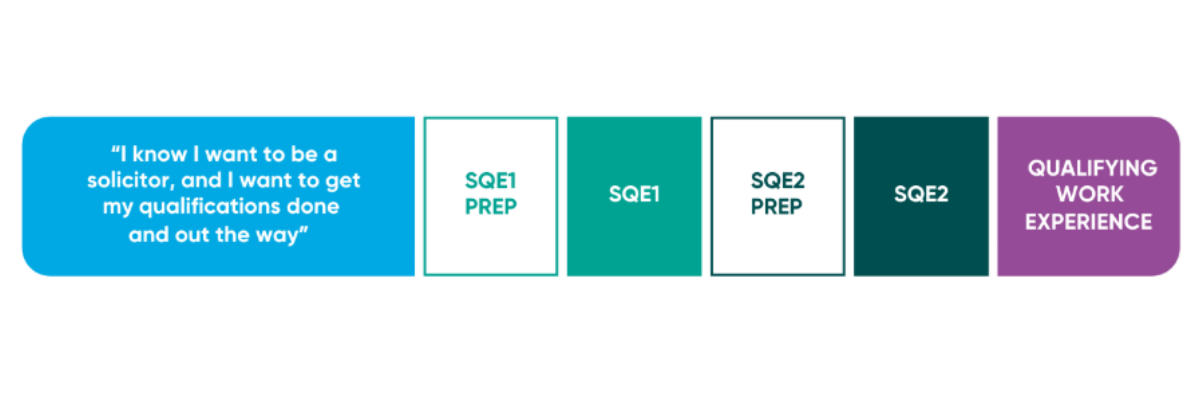
- Focus on studying first and complete SQE1 and SQE2 prep courses or an LLM in Legal Practice with SQE prep
- Then start your two years QWE This route is ideal for those students who are keen to continue with full-time study, or who haven’t been able to get a role in the legal sector after graduating. You can take and pass SQE1 and SQE2 in just over a year, if you pass both SQE1 and SQE2 first time.
Pros: Full focus on studying for the SQE exams through 30-35 hours of study a week.
Cons: Short preparation courses. pressure to take SQE exams quickly, lack of time to work and save funds for the SQE course fees and exams.
2. Integrated 'Earn and Learn' Pathway
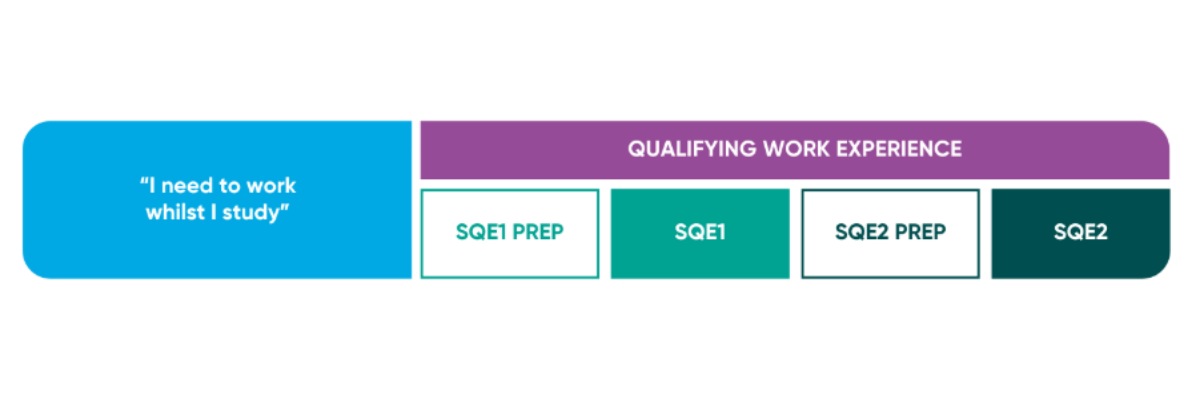
- Study part-time for the SQE while working
- Build your QWE alongside your studies
“I honestly don't think I would have been able to secure my training contract without doing paralegal experience first.”
— Michelle, Liaison Officer
This route works if you are already in a legal role or looking for an entry level position which will give you great experience. You can progress your legal career whilst you study for the exams. If you are going to study alongside your work, The College of Legal Practice recommends that you take 40-week preparation courses – so a year for SQE1 and a year for SQE2.
Pros: Progressing your QWE will help you both secure your two years QWE and progress your legal career, you will be earning income to fund study and exams costs.
Cons: Balancing your work and study can be very demanding, particularly if you have secured a paralegal or client facing role. Watch out for burnout and stress, as preparation for the SQE can be intense.
3. Unsure Integrated 'Earn and Learn' Pathway
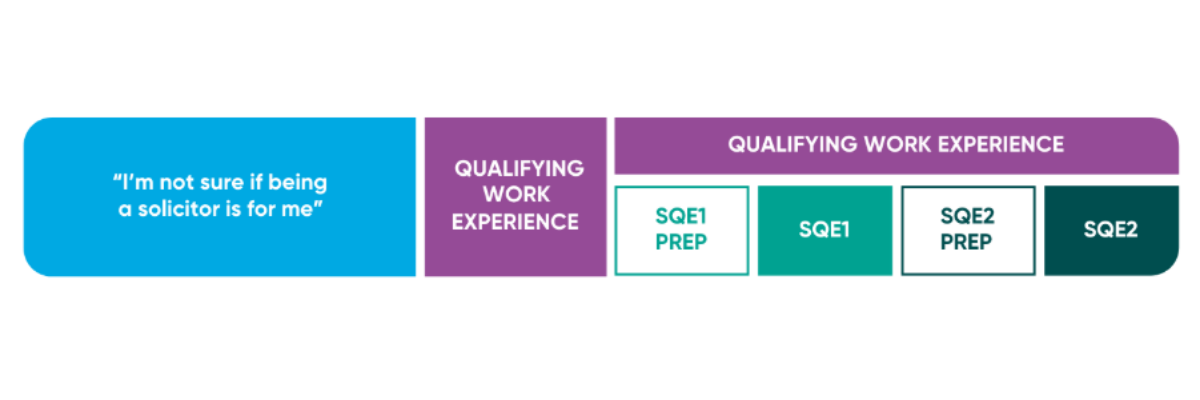
- Not sure yet whether you want to be a solicitor? That’s okay
- Explore working in the legal sector first, before you start your SQE study
- Don’t start SQE preparation until you are sure that you want to become a solicitor!
“Being a paralegal allowed me to try out the legal field before committing to it... it was a way to test it out and have an inside look into the work environment.”
— Nabeala, Solicitor and Supervisor at The College of Legal Practice
This pathway is smart! It will help anyone who is unsure about becoming a solicitor. Spend some time in the legal sector, observing solicitors, understanding how firms operate and seeing whether it is a career path that you want to take.
Pros: You don’t waste money on preparation courses and SQE exams until you are sure you want to qualify, you can explore the legal sector without time pressures of study, whilst saving money to pay for future study and exam fees.
Cons: This route may take a little longer, but we find these students are very determined and well informed when they decide to start their study. That motivation and commitment can take you a long way to passing the SQE!
What is Qualifying Work Experience (QWE)?
“You can start your qualifying work experience from the moment you begin your course, and it can be carried out at the legal clinics of different firms, so it takes off the pressure of obtaining a single training contract.” — Monica, Conveyancing Solicitor
Qualifying Work Experience is defined by the type of work that you carry out. You must demonstrate that you are delivering legal services work at the standard of more than one of the solicitor competencies required by the SRA. It can’t be administrative, or compliance work, it must be delivering legal services to clients.
There are a number of things that make Qualifying Work Experience more flexible that a traditional training contract:
- Firstly, you can gain your two years’ QWE experience in up to four organisations, with varying length of placements.
- Secondly, for your QWE to count, it doesn’t matter what role you hold, your job title, what you are paid, type of organisation or location that it is based in. The only thing that matters is that you are delivering legal services in a legal services organisation
- Lastly, as the pathways illustrate above, you can gain QWE before your SQE exams. So even at University, if you have been volunteering for example in a law clinic, you can start gaining QWE. It doesn’t matter when you start or finish your QWE
Top tip: If you think your role might be QWE, have an early conversation with your supervisor to get them to confirm it for you when you complete the placement or two years. An SRA registered solicitor or Compliance Officer has to confirm your QWE for you.
You can find out more about what is QWE on the College’s website.
What are the SQE exams?
The SQE assessments are central exams in test centres (like when you take your driving theory test). SQE1 tests your legal knowledge and SQE2 tests legal knowledge and your legal skills. The SRA have set the standard of these exams to be the equivalent of Day One Newly Qualified Solicitor. So, they are harder than an LPC and any undergraduate degree. You have to pay a fee to sit each exam, and if you need to resit, you must wait until the next sitting and pay again. You can sit each exam up to three times.
SQE1: cost is £2,006 for 26-27
You will be tested on 13 areas of legal knowledge in four 2.5 hour exams over two days. The exam assessment is a series of single-best-answer questions, much like multiple-choice but harder. It isn’t easy, so significant study time is a must.
SQE2: cost is £3,086 for 26-27
You will be assessed on your interviewing, advocacy, writing, research and drafting skills in 16 assessments over a three-week period. The oral exams are held face-to-face at four test centres: London, Cardiff, Manchester and Birmingham. You may need to budget extra for travel and accommodation.
Preparing for the SQE exams
There are lots of different ways that you can prepare for the exams, there is no one correct way to do this! You can buy materials, courses and enrol on full Masters Programmes (like the College’s LLM in Legal Practice). Do your research, look at reviews, ask other students and work out the best option for you.
To get the most out of your preparation, we recommend:
- Completing all the learning given to you to the deadlines on the course
- Attending your tutor sessions; they can guide you and help you prioritise and assess how you are progressing
- Testing yourself regularly with timed mock exams to track your progress and prepare you for the real exam experience
“The SQE1 assessment consists of two papers: FLK1 and FLK2. You’ll need to apply legal principles to client problems using single best answer questions. Independent study is key - use the progress tests, supervisor sessions, and study materials to stay on track.”
— Steve Johnson, SQE1 Module Leader at The College of Legal Practice
Read more about SQE preparation.
Worried About Costs
You’re not alone. Many students worry about how they’ll afford the SQE exams and preparation courses but there are options to help you manage the cost.
Funding Options Include:
- Choosing an affordable course: Research into course providers. There are a wide range of SQE course providers out there, with course fees ranging from just over £2,000 for SQE1 prep to over £20,000 for some Master’s programmes
- Pay by instalments: Many organisations will offer interest free instalment plans that help you spread out the costs of study for the SQE
- Study online: Studying online can save you significant time and money and help you manage your work and personal commitments alongside your SQE study
- Take a longer course: Taking a longer preparation course will help with spreading out fee payments and saving for the SQE exam fees
- Postgraduate loans If you study the SQE through an LLM (Master’s) route, you may be eligible for a government postgraduate loan if you are based in the UK. The College’s LLM in Legal Practice costs £7,245 and you can receive a loan for £13,206 for 26-27*.
- Scholarships and Access Funds: Lots of organisations offer discounts and scholarship programmes for students with financial challenges and from under-represented groups. Sign up for updates from The College of Legal Practice, Legal Social Mobility Fund, The Law Society Diversity Access Scheme and Regional Law Societies so you hear about them when they open
“I am not in a position to throw money at the course and exams, nor are my employers owing to the obvious nature of funding in the charity sector. So, I determined I needed a course where I could rely on a postgraduate loan… The College were offering an affordable LLM. Tuition and leaving enough money to cover the actual SQE exams as well!”
— Dan Abel, Qualified Solicitor
Tips for Getting Started in Securing QWE
- Attend law fairs and insight days. Many of these experiences are virtual and nearly all are free. Plan the questions in advance for the people and firms you meet, so you can make a well-informed and positive impression.
- Volunteer with Citizens Advice or law clinics. Any experience will help you learn about being a lawyer and managing clients.
- Shadow a solicitor or paralegal. Pick a high street or local solicitor, just to get started and ask them if you can spend a day there. If you don’t know anyone who works in a solicitor firm, write letters, drop in and try the personal approach.
- Connect with legal professionals in Regional Junior Lawyer Divisions and on LinkedIn. Many trainees and solicitors are always happy to help but do your research first before you approach them. Why them, are they in the area of practice that you are interested in, what do you have in common?
- Apply for internships or vacation schemes. These formal opportunities are a fantastic way of getting an in-depth experience of working at firm so you can decide if it is the right path for you. They are also competitive so do your research.
- Graduate entry roles: There are many graduate entry positions that can launch your legal career. Look beyond the training contracts - many firms promote internally and you may have more chance of progressing to a trainee from a paralegal position.
“My biggest networking tip is to treat the person you are speaking to as a human being, not their title... They are far more likely to want to help you and also remember you.”
— Maab, In-House Trainee Solicitor
A More Inclusive Legal Profession
The SQE is aiming to help to diversify the legal profession by removing the bottleneck of training contracts and making qualification more accessible.
“The legal industry is made for anyone and everyone. There are so many different sectors, avenues and opportunities for all kinds of people.”
— Salma, Senior Paralegal and SQE Student
Want More Help?
Download our full Become a Solicitor Guide, packed with advice, real stories, and practical steps. Discover what kind of solicitor you might want to be and the key skills that you’ll need to succeed.
Download your copy of the guide
*Master’s loan levels vary across the UK and eligibility requirements apply.